
Details
- Great Britain & N.Ireland
- BaWiSo-19
- Undergraduate
- SoSe 2026
- Time spent at the partner university: 4 months
- Contact: Login to see contact information

For my journey to Brighton, I chose to fly with Austrian Airlines to London Heathrow, mainly because I was travelling with quite a lot of luggage and preferred not to use a low-cost airline. Since Austrian Airlines does not fly to Gatwick, which would have been more convenient for Brighton, I booked a taxi from Heathrow directly to the University of Sussex using the university’s discount code. This was definitely quite expensive, especially as I was travelling alone, but for my first arrival in a new country with all my luggage, it was the most comfortable and stress-free option. For my return journey, I used the coach instead, which was much cheaper, so I would recommend looking into public transport options in advance if you want to save money. In terms of preparation, communication from the University of Sussex was generally very good and I received the necessary information before my arrival. I did not take out any additional insurance, as travel insurance was already included with my credit card. Overall, the preparation was quite straightforward, and I would mainly recommend organising your journey in advance and checking the different transport options between the London airports and Brighton.
I chose one of the accommodation options offered directly by the University of Sussex. Out of the three options available to exchange students, I went for the most expensive one because having an en-suite bathroom was important to me. The number of people sharing a flat was quite similar across the different options, and since the price difference between the mid-range and en-suite option was not that large, I personally preferred paying a little more rather than sharing a bathroom with people I did not know beforehand. Flats are mixed-gender, and the level of cleanliness can obviously depend a lot on your flatmates. I was very lucky with my flat, as all of my flatmates were exchange students and we all moved in at the same time, so the flat was very clean when we arrived. Another big advantage was the cleaning service: a cleaner came every week to vacuum and clean the common areas, and even the en-suite bathroom was cleaned approximately every two weeks, which I had not expected at all. The cleaning staff were also always very friendly. The university provides useful information before arrival, including the possibility to order bedding packs in advance. Kitchen equipment such as pans and other utensils has to be organised yourself, but there was also a box with items left behind by previous students, which was very useful for picking up things without having to buy everything new. Each residential area on campus also has a reception/front desk that can be contacted if something in the accommodation is not working. We did experience a few maintenance issues and power cuts towards the end of the semester, and sometimes repairs took a little longer, but overall the support was good. I would personally recommend living on campus for an exchange semester. Most students living there are either first-year or exchange students, while many older Sussex students live in Brighton after their first year. I was 22 and already among the older students in many situations, which is something worth knowing beforehand. Living on campus made the whole experience very easy and social, and I personally preferred the security and convenience of university accommodation over finding a private room in Brighton without knowing the future flatmates.
Campus life was one of the things I really enjoyed about the University of Sussex. The campus almost feels like a small town of its own and, at times, a little like the stereotypical campus life you know from American movies. There is a supermarket, several restaurants and cafés, and many places to spend time between classes. Compared to WU, I was especially surprised by the variety of food options. Some of the restaurants are actual chains that can also be found in Brighton, so parts of the campus almost feel like a small food court. There is also a more traditional and much cheaper canteen option. The food there was not necessarily the most exciting, but it was affordable and did the job. The library was another place where I noticed some differences compared to WU. The atmosphere felt quite relaxed, as you could take your bags and even food with you into the library. There is also a Costa inside the library and a Starbucks in the Business School building, which added to the overall campus feeling. Academically, one of the biggest differences compared to WU is the number and structure of courses. At Sussex, students usually take around four modules per semester, with five being more of an exception. Each module runs throughout the semester. Coming from WU, where it is normal to take many more individual courses and have courses with different durations throughout the semester, this took some getting used to. There was no strict mandatory attendance in my modules, although attendance was recorded through codes shown during class. Especially for early classes or during the colder winter months, it could therefore be tempting to skip a class. In terms of teaching style, I found the experience particularly interesting. My modules included quite a lot of group work, which was not that different from what I was used to at WU. However, I felt that many topics were approached in a more hands-on way. Case studies were not only used as short exercises but often served as a starting point for broader discussions. I particularly enjoyed how business topics were connected to social, ethical and regulatory questions and discussed from different perspectives. This gave me a different perspective on topics I had already encountered in my studies at WU. I also found it interesting that the companies and examples discussed in class were naturally quite different from the ones I was used to in Austria. Companies such as Tony’s Chocolonely, for example, appeared quite frequently in discussions and case studies. Through the courses, I also learned much more about the UK context, including regulations and perspectives within British academia and business. These are insights I probably would not have gained in the same way without studying in the UK for a semester. Regarding course recommendations, I generally had a positive experience with all of my business modules. Corporate Social Responsibility, Sustainability and Business Ethics required the most continuous work throughout the semester, while Leading Groups and Teams (LEAD) was probably the most interactive module in class. People, Purpose and Performance was also a very positive experience, with a very friendly lecturer, presentations during the semester and a take-home exam as part of the assessment. Managing Sustainability in Global Value Chains was probably the module that challenged me the most and exposed me most clearly to a different academic approach. It required extensive research and the use of many academic sources, and the lecturer had very high subject expertise. I sometimes felt less prepared for this type of work than in my other modules, but it was also the course in which I engaged with the most unfamiliar topics and noticed the differences between the two universities most strongly.
for the entire exchange
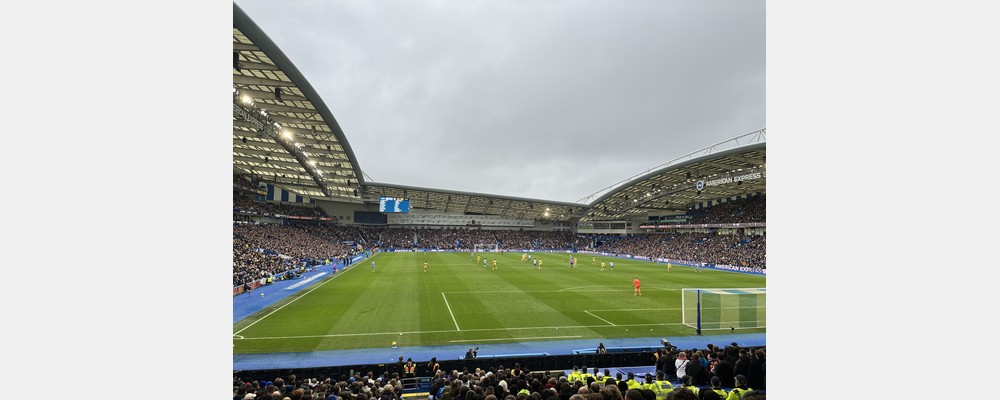
One of my absolute highlights was living so close to the Amex Stadium, which is only around a 20-minute walk from campus. As a huge football fan, I went to as many Brighton games as I could and absolutely loved the atmosphere. I would definitely recommend going to at least one match even if you are not particularly interested in football, as the whole area around campus comes alive on matchdays and the student bar near the campus entrance fills up with fans. If you are a football fan and plan on attending several matches, I would recommend getting a membership, as many games sell out or tickets are initially only available to members. Getting into Brighton from campus is also very easy. The bus takes around 30 minutes and runs directly from the university into the city and towards the pier. Although there were occasional issues with the buses, they generally ran regularly, including at night. I only used Uber once or twice, mostly out of convenience rather than necessity. There is also a supermarket directly on campus, which is very convenient for everyday essentials. It is quite expensive, but it has almost everything you might need, so it was very useful when I did not want to go into the city just for groceries. Brighton itself has a lot to offer, and the pier and seafront were some of my favourite places. However, I definitely underestimated how windy the coast would be. I had imagined spending much more time relaxing at the beach, but until around May it was usually too cold and windy for that. On the positive side, the winter felt noticeably milder than in Vienna, although it did rain quite frequently. Another big advantage of living in Brighton is the proximity to London. The train journey takes around one and a half hours, so we went to London quite regularly and it was very easy to do as a day trip. However, travelling back and forth can get expensive quite quickly. I would therefore definitely recommend getting a Railcard and using Trainline to book tickets, as this can make train travel significantly cheaper. Having London so close by was a huge plus for me and made spontaneous day trips very easy. Something I had not expected before my exchange was how much I would travel. Many of my closest friends were exchange students from outside Europe who wanted to use their semester abroad to explore Europe as well as the UK. As a result, we travelled together quite a lot, including trips to Venice, Malta and Ireland. This became a really memorable part of my exchange, although it also meant that I probably did not explore as much of England or take advantage of every activity Brighton itself had to offer. In terms of social life, I would have appreciated more activities organised specifically for exchange students by the university. Since I arrived for the second semester, the academic year was already well underway and there were fewer of the introductory events that take place at the beginning of the year. For this reason, I can imagine that arriving in the first semester might provide a somewhat different experience. Most students living on campus are also quite young, and at 22/23 I often felt like one of the older people at student events and clubs. Brighton itself, however, has a much broader nightlife and social scene beyond the university, so there are plenty of options outside the typical student environment as well.
My semester abroad somehow turned into an exchange semester not only in Sussex, but all over Europe. Most importantly, I proved to myself that I could see myself doing a Master’s degree in an English-speaking environment and that I can build real friendships in English – which was one of the main reasons why I wanted to go abroad in the first place. I met amazing people, travelled much more than expected and became even more certain that I love living abroad and getting out of my usual environment. Overall, it was exactly the kind of experience I had hoped for, just in ways I did not necessarily expect. Up the Albion!